Establishment Think Tanks Herald End of American Hegemony
The Western establishment continues to slowly and torturously come to grips with the hegemonic collapse of America in the Middle East.
The Council on Foreign Relations think tank’s journal has released their latest, penned by Marc Lynch, the man who coined the term Arab Spring:
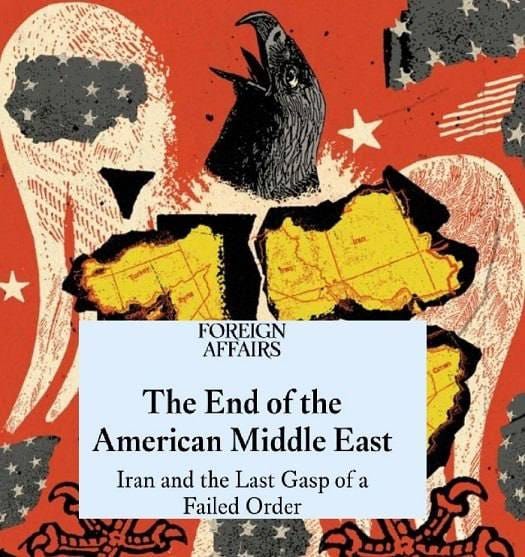
Its opening sentence tells the whole story:
The American Middle East is finished.
The regional order that has prevailed since 1991 has been one of the many casualties of the U.S.-Israeli war with Iran. The American and Israeli failure to dislodge the regime in Tehran has proved the bankruptcy of decades of sanctions and violence. The inability of the United States to protect its Gulf allies from Iranian attacks or to keep the Strait of Hormuz open has fatally undermined the core security bargain that justified its network of military bases in the region. And Israel’s increasingly threatening posture and abandonment of any pretense of interest in reaching an accommodation with the Palestinians have ended Washington’s decades-long mission of bringing its Arab allies and Israel together into an enduring security partnership.
In short: Israel’s unalloyed pursuit of accelerationism in regard to its geopolitical plans has destroyed the very fabric that ensured Israeli-American regional dominance.
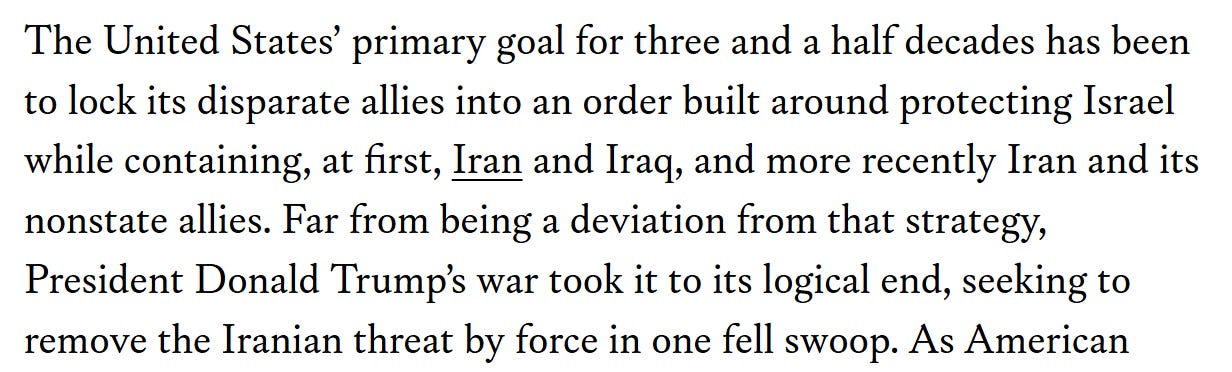
The piece argues that just like the Suez Crisis of 1956 was the “last gasp” of French and British colonial power in the Mideast, so too will the Iran war be for American hegemony. New alliances are being forged daily, as Turkey, Pakistan, and Saudi Arabia signed a new defense pact earlier this month, while Turkey began quietly shipping more military arms to Jolani’s New Syria in preparation for a future stage of conflict against Israel; Israel itself has been ‘studying’ whether NATO’s Article Five would be activated by strikes on Turkey.
The article goes on to detail at length the careful balancing act the United States has been attempting to carry out in the Middle East for decades, typically leveraging its own presumed-to-be unrivaled might whilst usually sidelining genuine Arab interests in the region.
…the architects of this war vastly exaggerated what military power could achieve, underestimated the capacity of adversaries to adapt, took for granted that allies would fall in line, and callously disregarded the lives of ordinary people. Washington’s misadventure was not an aberration so much as the ultimate _expression_ of the inherent vice of its Middle East strategy.
But the problem is, the entire system was built on a series of fragile contradictions from the very start, not least of which being Israel’s taboo possession of nuclear weapons, a greatly destabilizing circumstance which virtually ensures Iran’s existential-level pursuit of asymmetrical deterrence in the region.
The entire present Middle Eastern crisis can be explained by the logical fault of Israel’s ahistorical existence. Every explanation of current hostilities can be chain-deduced down to this. Ask why Israel needs nuclear weapons, the answer given is because it is a vulnerably small nation surrounded by hostile neighbors. But ask why the countries are hostile to begin with, you will be taken for a loop of equivocating mental gymnastics that ignore true first principles: that Israel is an artificial colony imposed on a region in a way that unnaturally disturbs the region’s cultural fabric, requiring Israel to in perpetuity feign “defense” against the host’s antibodies when it is in fact the invading parasite. Everything else extends from this basic premise.
The fact is, you are not entitled to “your own land”, where someone else has lived for thousands of years, based on a book of fiction from many millennia ago which features flying giants, sea monsters, and talking serpents. If this were the case, Native Americans could dig up some ancient scriptures of their own proving North America belongs to them and should be promptly handed over to their administration.
But most remarkably, the Foreign Affairs piece calls for the US to completely abandon its current Mideast policies in a total regional reset, and in essence switch to a ‘passive’ mode of operations therein:
That starts with renouncing the use of military intervention as a first resort and ending the practice of diplomacy by airstrike. Washington’s priority should be defense, not offense. One way to make that intention clear is to forgo the restoration of damaged or destroyed U.S. military bases across the Gulf and focus instead on investments in intelligence sharing, missile defense systems for Gulf partners, and the preservation of freedom of navigation through the Strait of Hormuz.
For one of the most influential establishment think tanks to call for the US to not bother restoring its destroyed bases in the Middle East is a quite shocking development, and serves as another wake-up call to how fast things have changed.
They go on:
The United States must pursue stability in the Middle East through diplomacy and collective defense, not militarized containment. The Iran fiasco has thoroughly exposed the hollowness of hawkish calls for war and promises of decisive action. It is time for Washington to commit to a diplomatic process that can bring Iran into the regional security system as an invested partner.
Even more eye-openingly, they call for a reimagining of the US-Israeli relationship, and even for the US to stop pressuring Lebanon to disarm Hezbollah:
The reset in U.S. policy must also extend to the way Washington treats its allies. This includes Israel. Conditions are ripe for a rethinking of the U.S.-Israeli relationship: according to a Quinnipiac poll released in June, nearly two-thirds of Democrats and more than half of independents think the United States is too supportive of Israel. In mid-July, more than half the Democrats in the House of Representatives voted for a bill to cut off U.S. military aid to Israel. The next administration should use this momentum to put the kind of pressure on Israel that U.S. governments have long shied away from. Washington neednot abandon its ally, but it should demand that Israel respect human rights within all the territories it controls, stop the creeping annexation of the West Bank, and end its destabilizing interventions in Lebanon and Syria.
One can easily argue this is just more empty lip service, as usual, but it’s clear some kind of seachange is in the air, as establishment thought leaders have essentially exhausted their patience and tolerance for Israel’s calamitous primacy over US foreign policy.
They conclude on a note of promise for the region which almost reads genuine:
New American policies would not create a stable, peaceful Middle East overnight. At first, they would win little public applause from a region that has grown accustomed to American hypocrisy and abuse. Later on, the rise of more democratically responsive governments in the region would likely cause considerable headaches as ambitious politicians competed to condemn and denounce the United States. But in the long run, a Middle East populated by regimes that are less willing to follow Washington’s lead on unpopular policies or to suppress public opposition would likely be more stable than the region of today. Washington struggles to conceive of a Middle East it does not dominate and to imagine real alternatives to the present regional order no matter how badly it has failed. But that order is ending, and this may be U.S. leaders’ last chance to change course. If they cannot, they will watch the American Middle East fade away like the European empires that came before.
An increasing number of publications are converging on the breakdown of America’s putative global authority:
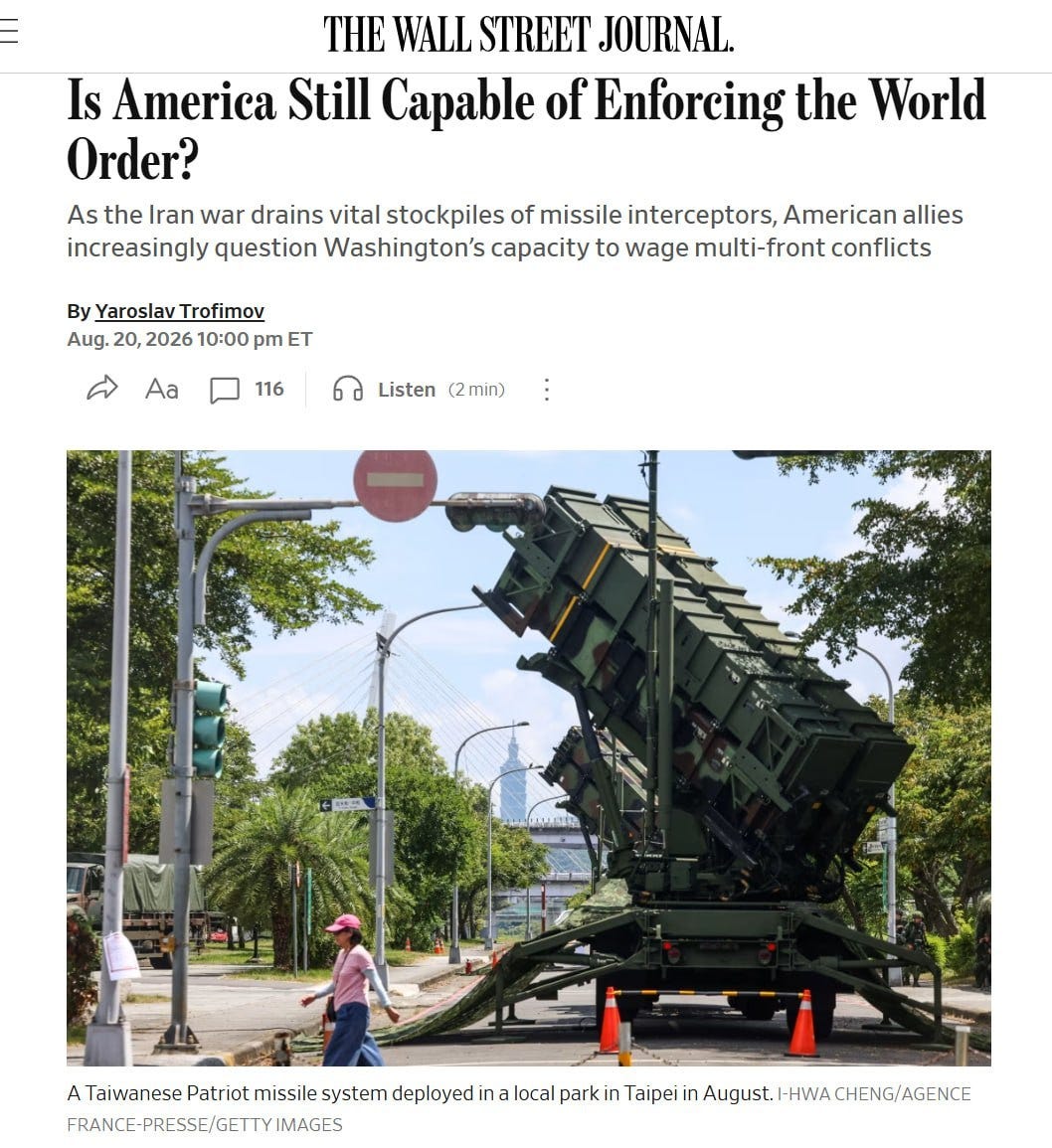
The piece reveals the main question on the minds of America’s allies—one they have likely already answered for themselves in private:
The question that officials in allied—and adversary—capitals are asking themselves is whether industrial decline, strategic incoherence and political dysfunction have weakened the U.S. to the point where it would no longer wield decisive force in a multi-front conflict that may encompass Europe, the Middle East and Asia. It is a concern shared by many in Washington, too.
The problem is, of course, that the rest of America’s allies remain so pitiably weak in comparison that even America’s greatest decline in history still puts the nation well ahead. One can perhaps attribute this to great strategic planning on the US’s behalf in years prior, stifling and covertly sabotaging allies to guarantee they always remain subservient stepping stools even on a rainy day.
The piece reveals that the Europeans, for instance, privately acknowledge that the US would do nothing were Russia to attack the Baltics:
While paying lip service to the NATO alliance in public, European officials are increasingly doubtful in private that Trump’s America will help them in case Russia attacks. “Unofficially, we all know that they won’t risk their security for the sake of the Baltic states, or for the sake of Germany,” said retired colonel Roderich Kiesewetter, a lawmaker from Germany’s ruling party. “The American nuclear umbrella is gone.”
Coming full circle in its search for some hope in salvaging this ‘Western’ agenda, the Spectator in its latest edition tries to keep a stiff upper lip in the discourse, by pleading that the West can still be saved:
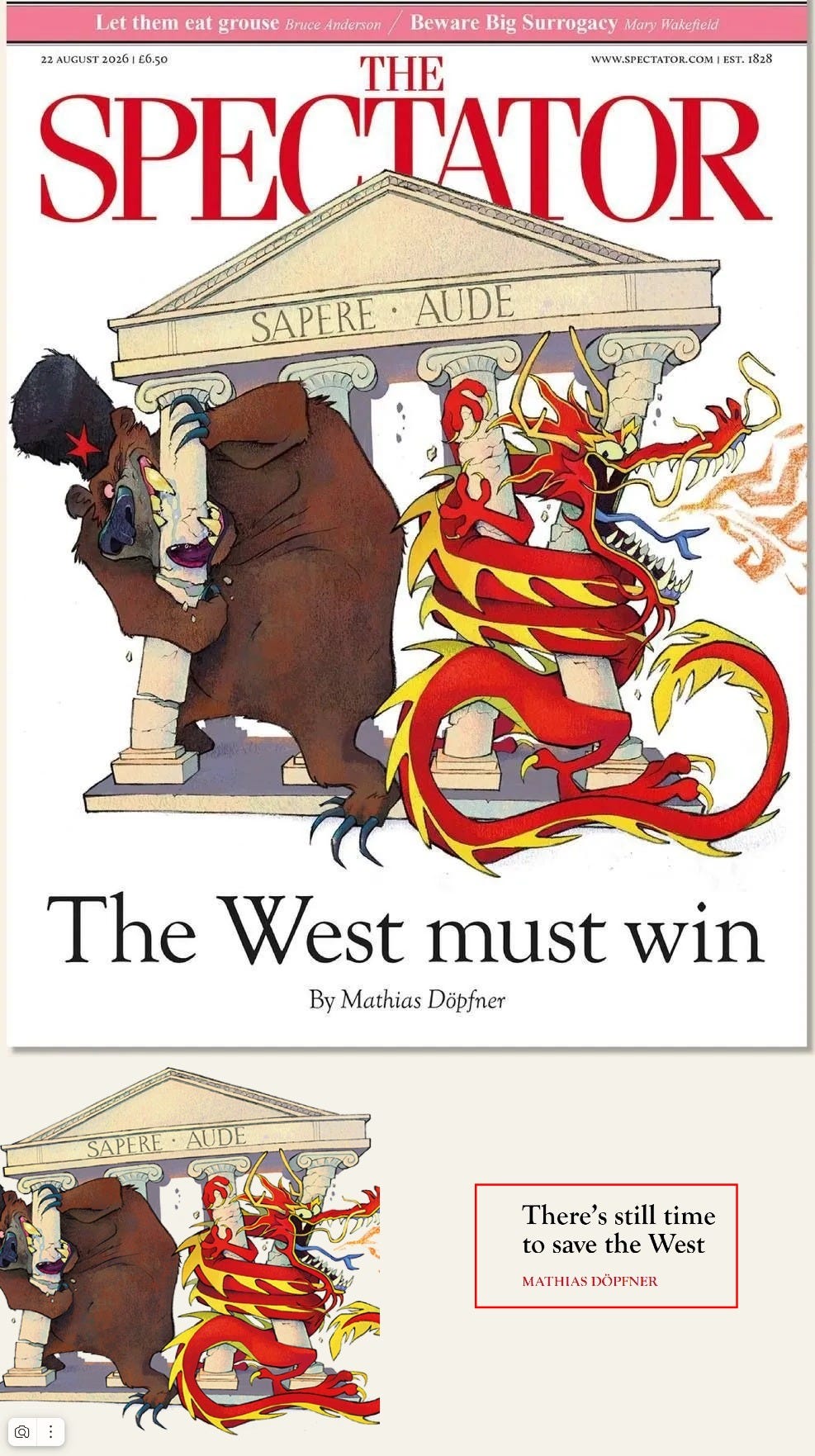
The author tries his hand at identifying what precisely about this idea of the “West” must be salvaged, and why, calling the West an invalid that must be ‘strengthened’:
What exactly, though, needs to be strengthened? The West is an idea, not a location. It is not a matter of geography, it is a way of life. The idea of the West rests on four pillars: Athens – where democracy was born. Rome – the cradle of the rule of law. Jerusalem – where Judeo-Christian values placed the inviolable dignity of the individual at the centre. And finally, the Enlightenment – whose great thinkers in London, Paris and Königsberg anchored humanism, individual civil liberties, the separation of powers and the division of church and state.
We already know the drill: these establishment flacks use the ‘West’ as euphemism for the globalist order, plying us with pathos-stirring appeals to emotion as to how we’re all “culturally bound” by some kind of religiose core Western fabric that must be defended at all costs against the dark Oriental hordes that threaten our collective “civilization”. To deny these self-professed realities is to betray ourselves, they would like us to believe.
But the truth is that the oligarchic private finance mafia which controls this so-called ‘West’ is the one that’s already betrayed us all, enslaving us under a false idol of Western supremacy which must be rewarded with our undying allegiance and conformity to their imposed system. It is the ultimate subversion by an enemy within, masquerading as the savior against the conveniently invisible hordes on our collective periphery.
Just imbibe of the syllogistic casuistry employed by this agent of our immutable “West” to ensure we don’t take for granted the holy nature of our ‘democracies’. As always, the bromide-fueled screed reduces the world to black-and-white binaries to encode us against the eternal ‘Other’:
Freedom’s most important word is ‘no’. Dissent is self-determination. It is liberating to say: ‘No, I see it differently.’ With ‘no’, the freedom to think and act begins. The freedom to say ‘no’ stands in stark contrast to the unfreedom of having to say ‘yes’. Democracies are no-saying societies, while dictatorships are yes-saying. Liberty is inherently critical of authority: it permits and encourages contradiction – precisely that which autocrats cannot abide. That is why dictators wish to weaken the West. And it begins, as so often, with words.
Like clockwork, after our little Two Minutes Hate session above, we are directed toward the adversary, as the beady-eyed mic-man whispers goads in our ears:
The West is currently threatened and weakened from both without and within. Its three great external adversaries are China, Russia and Islamism – particularly Iran and its terrorist networks. China, Russia and Islamist dictatorships share a common objective: to divide the West in order to weaken it.
How patently predictable.
The article proceeds through a slalom of contradictory hyperbole against China, Islam, and the other state-designated ‘enemies’ of our civilization, never once answering the premise of defining what actually comprises the heart of the so-called ‘West’.
In fact, in a bit of unintentional irony, the piece seems to liken the West to God, something whose image cannot be described other than apophatically. In the very opening paragraph the author laments the exertion of even being forced to explain what the West really is:
That we must explain and justify ‘the West’ at all indicates just how weak it has become.
Apparently, our collective ignorance of the West’s core unifying attributes can only be resolved via negativa: describing not what the West is, but rather what it cannot be. In doing so, the author succeeds in painting us a vivid picture not of the West’s chief unifying ethos, but rather of all the dark and evil things which exist outside the West’s ivory gates. We are then induced to irrationally fear these things simply because they are not our ‘West’, a thing which remains vague and undefined, but whose existence we are simply to take in good faith.
It is telling that in his only attempt to define the West at the outset, the author goes down a list of ancient cultural centers like Athens, Rome, and Jerusalem. If a thing can only be defined by its long-expired vestiges, then maybe it’s time to admit that it simply does not exist anymore. Maybe it’s not the swarthy Eastern hordes at the gates we must fear, but the people who put them there. The same people who’ve stirred global unrest, displaced millions via Forever Wars, and who now wear the convenient sheepskin of the ‘West’ to misdirect us away from their own global subjugation.
As the Spectator cover correctly notes: Sapere Aude.
Special thanks to you, the paid subscribers, who are reading this paywalled Premium article—you are the core contributing members keeping this blog in healthy, steadfast operation.